|
Other roles and affiliations:
Director: Program in Cognitive Affective Neuroscience (PICAN) Professor: Center for the Neural Basis of Cognition, Pitt Clinical and Translational Sciences Institute (CTSI) |
 |
Web-based projects include:
I received my Ph.D. through the San
Diego State University / University of California, San Diego Joint Doctoral
Program in Clinical Psychology.
Neurotranslational article repository
Neuroscience of race-based biases, racism, stereotypes, and prejudice
The fMRI Individual Differences Database with contribution instructions.
The Functional Connectivity Toolbox as referenced in Zhou et al (2009) Neuroimage, 47:1590-1607.
Interactive, editable reference list for Neurobehavioral Training and Cognitive Training papers, software, and downloads.
Please feel free to add to this! Also available as pdf snapshot from 10/19/2011.
The
Balanced Affective Word List Project and the
STROBE checklist for what to report in cohort, case-control, and cross-sectional studies
CONSORT checklist for what to report for clinical trials
COBIDAS report on how to report on fMRI studies
Guidelines papers for psychophysiology for reporting on psychophysiological studies of all types including heart rate variability, startle, EMG, heart rate, EEG, MEG, ERPs, blood pressure, GSR, etc. They are at the bottom of the page - scroll all the way down.
Time-line and some hints for obtaining an NIH K-award is a now-viral document that Judy Ford and I put together for post-docs and junior faculty who are thinking of writing a K-award application. Do not be scared.
Thoughts on writing an F31 NRSA award from Siegle, G.J., Johnson, S. L., Everhart, D.E., Newton, T. (2010). Tips on writing National Research Service Award Predoctoral Fellowship proposals from real NRSA reviewers. The Behavior Therapist, 33, 160-164.
Hints on giving a poster at a conference
Hints on writing a (compassionate) review for a manuscript
Thoughts on interacting with the media
Thoughts on maintaining a hyperfunctional psychology laboratory
Being Borderline - An Operator's Manual, an unpublished underground how-to guide I wrote for patients in 2000. Most of the information remains current.
Code to read and deblink ASL5000 pupil data on 64-bit Windows 10 computers running matlab.. This zip file has a pdf that explains how it works and where to install things.
Pupillary waveform deblinking Matlab code identifies and linearly interpolates through blinks in a waveform of pupillary motility data. Usually works on eyetracking data as well as other relatively physiological waveforms scaled appropriately.
Windsorizing Matlab code rescales outliers to the last good value within the Tukey hinges within columns of a matrix.
Waveform comparisons Matlab code implements tests to compare physiological waveforms at every sample, as used in a bunch of my lab's publications. Please install all directories in your matlab path and do check out the documention in the pupil_toolkit_waveform_comparisons.pdf file in the main directory.
The Pupil Toolkit. This is the motly collection of matlab code my lab uses to analyze our pupil data. Typically, using it involves either you visiting my lab or me visiting you for a day or two, working to make sure we can read your data, and process it, and writing example scripts together. This process has worked for many labs.
Emotiv Headset processing code. This is a collection of Matlab routines built on the FieldTrip and EEGlab matlab platforms. It implements a number of steps for processing data from the Emotiv Headset in a way that ERP and EEG data are interpretable and often comparable to data from much more expensive systems. Publications are forthcoming. It is a work in progress. Typically using it involves entering into a formal collaborative relationship where we are all authors on papers using the code. Site visits are a must.
fMRI code. This is a collection of scripts, c-source code, and matlab code used by our lab to process our fMRI data. Mostly we work on top of NIS and AFNI. If you want to use our code independently, as we do it, please consider doing a post-doc in my lab. That said, if you are using one of the fMRI tasks developed in my group and want to know whether your results would match ours if you just processed the data like we do, we are frequently up for re-analyzing your data, in collaboration with you.
The movie Blade Runner was set in November 2019 and put the use of pupilometry on the map. In honor of Blade Runner Day, the Program in Cognitive Affective Neuroscience and Biological Affect Modulation (BAM) lab (Kym Young, PI) have collaborated to record and show actual physiology (pupil dilation, EEG) on the Baseline Task used, in the movie, to determine whether a replicant is emotionally deviant. We proudly present a single case study of a decidedly human volunteer on that task here.
Please feel free to retweet the YouTube link: https://www.youtube.com/watch?v=-kRdoMpSU2s&feature=youtu.be.
Our Research Associate Integrity Agreement is signed by all associates doing research in or with the PICAN lab.
Initial thoughts on using the Emotiv Epoc in research. We're writing a paper but these are some initial questions people seem to ask a bunch.
On-line Preprints contains contents or links to some of the papers from my lab. Updated infrequently.
The Transdisciplinary Research in Emotion, Neuroscience, and Development (TREND) Artist in Residence Series brings artists and neuroscientists together to answer a question of mutual interest for 1-4 days each year.
Artists - you can apply! We are actively seeking an artist for 2012. To apply, please email Greg Siegle directly with 1) a brief description of a question you have about your art that neuroscience might help to answer and 2) a link to a website where your work can be found.
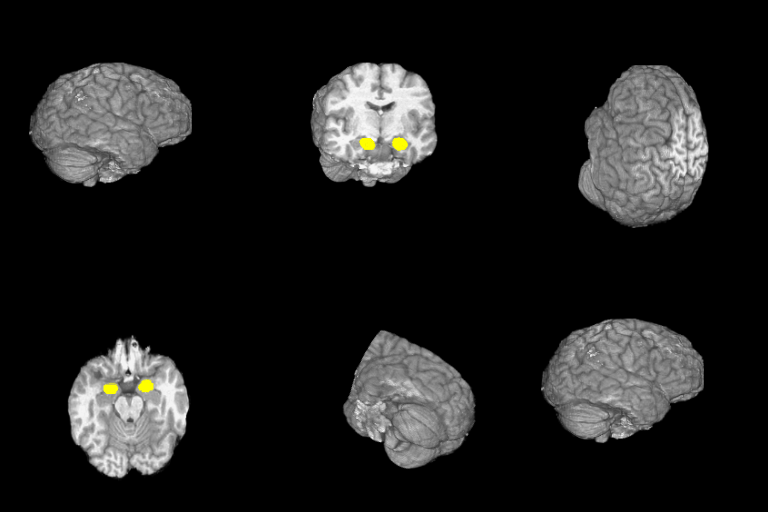
For inquiring minds: For the Siegle et al (2006) American Journal of Psychiatry treatment prediction paper, the BA25 ROI was centered around Talariach coordinates: 6, 17, -6 and extended from 6,17,-2 to 7,19,-11. The Amygdala ROI was maximal at 15,-3,-15 and extended from 13,-3,-14 to 19,-4,-17.
Here's an animation showing the mean of 25 control participants' brain activity associated with rating the personal relevance of positive words. The animation was made by generating a snapshot of regions significantly different (p<0.001) from the pre-trial baseline at each TR (1.5 seconds) for the 12 second trial (in AFNI), and interpolating between them (in Virtual Dub). As shown in the animation the anterior cingulate reacts early, followed slightly later by BA47, a brain region associated with rumination. Data from Siegle, G.J., Thompson, W., Thase, M.E., Steinhauer, S.R., Carter, C. S., (in press). Increased amygdala and decreased dorso-lateral prefrontal BOLD responses in unipolar depression: Related and independent features. Biological Psychiatry. Animation by Greg Siegle and Lena Gemmer.
Here's an animation showing the location of the amygdala. Roma Konecky and I made this from an SPGR image acquired on a 1.5T GE scanner using BrainVoyager to align and smooth the image, MRICro to trace the amygdala, AFNI to create the rendering, and WWW Gif Animator to concatenate the frames.
Here are a few interesting mathematical functions I've enjoyed playing with.